
HOA special districts: who is really in charge of your neighborhood?

You pay your HOA fees, follow the rules and show up to meetings. Then something happens that your HOA cannot fix, like a service change or a new charge, and you find out someone else decides. That someone else can be a special district, and HOA special districts are one of the least understood parts of living in a planned community.
This guide explains what a special district is, why it matters to owners, and the questions that help you find out who is responsible for what.
What HOA Special Districts Are
A special district is a local government body set up to provide a specific service, like water, roads or irrigation, for a defined area. It is separate from your HOA and separate from your city. State law explains how districts are created and run, and you can read the rules in Florida’s law on community development districts.
A community may have an HOA board, a district board and a city or county government, and each has its own role. Local news coverage of Gran Paradiso, a Florida community, described how those layers can overlap, as in this report on the irrigation dispute.
Why It Matters to Owners and Boards
Owners can pay in more than one place: HOA fees, plus charges or assessments from a district. If you do not know which body decides what, you may call the wrong office and wait for an answer that never comes.
For boards, the layers mean some decisions are outside the board’s control. A board that understands the structure can set honest expectations with owners and plan for what it cannot decide.
How Owners and Boards Should Handle It
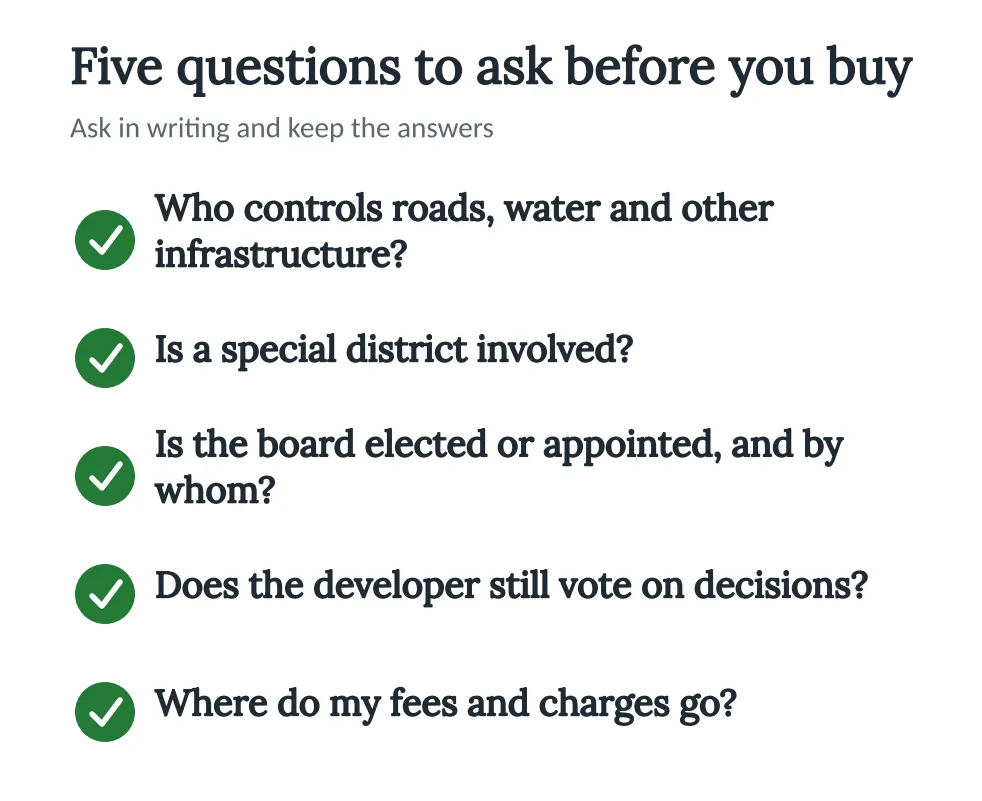
Ask Five Questions Before You Buy
The picture below shows five questions that help a buyer see how a community is structured.
Look at Your Tax and Fee Bills
Read every bill and note who sends it. Each name is a body that may have a say in your community. If a charge is unclear, call that body and ask what it pays for.
Keep a One-Page Map
Write down who handles each service: the HOA, the district, the city or county. Share it with owners. A simple page saves everyone phone calls.
Learn the Basics of Meetings
Understanding how HOA meetings work helps you follow district meetings too. Our guides to HOA meetings and quorum are a good start. If your board talks privately, our guide to executive sessions explains what is allowed.
Follow the Money
Ask how the HOA budget and any district charges fit together. Our post on how HOA meetings and finances connect shows where the two meet.
How Technology Can Help
When several bodies are involved, a board needs good records. Neighborhood.online helps a board run its meetings step by step: the agenda starts with the standing items filled in, the notice goes out on time, and the minutes are drafted from the meeting itself. Nothing goes out until the board approves it.
Neighborhood.online helps the board keep its own side of things clear. See how it works. The Free plan gives a community a website and a home for its documents.
Conclusion
Owners have a stronger voice when they know who decides what. This week, write down the bodies that send you bills or make decisions, and share the list with your neighbors.


