
HOA contract management: how to track vendor agreements without surprises

The landscaping contract renewed itself last month, at a higher price, because nobody remembered the cancellation deadline. The treasurer found out when the invoice arrived, and the person who signed the original agreement left the board two years ago.
That is what weak HOA contract management looks like. This guide explains what to track, what to read before anyone signs, and how a volunteer board can keep every vendor agreement from slipping through the cracks.
What HOA Contract Management Is
HOA contract management means keeping every agreement the association signs in one place, knowing its dates and terms, and acting on them before a deadline passes. The agreements include landscaping, pool service, snow removal, trash, insurance, management, legal and accounting services, and any one-time repair job.
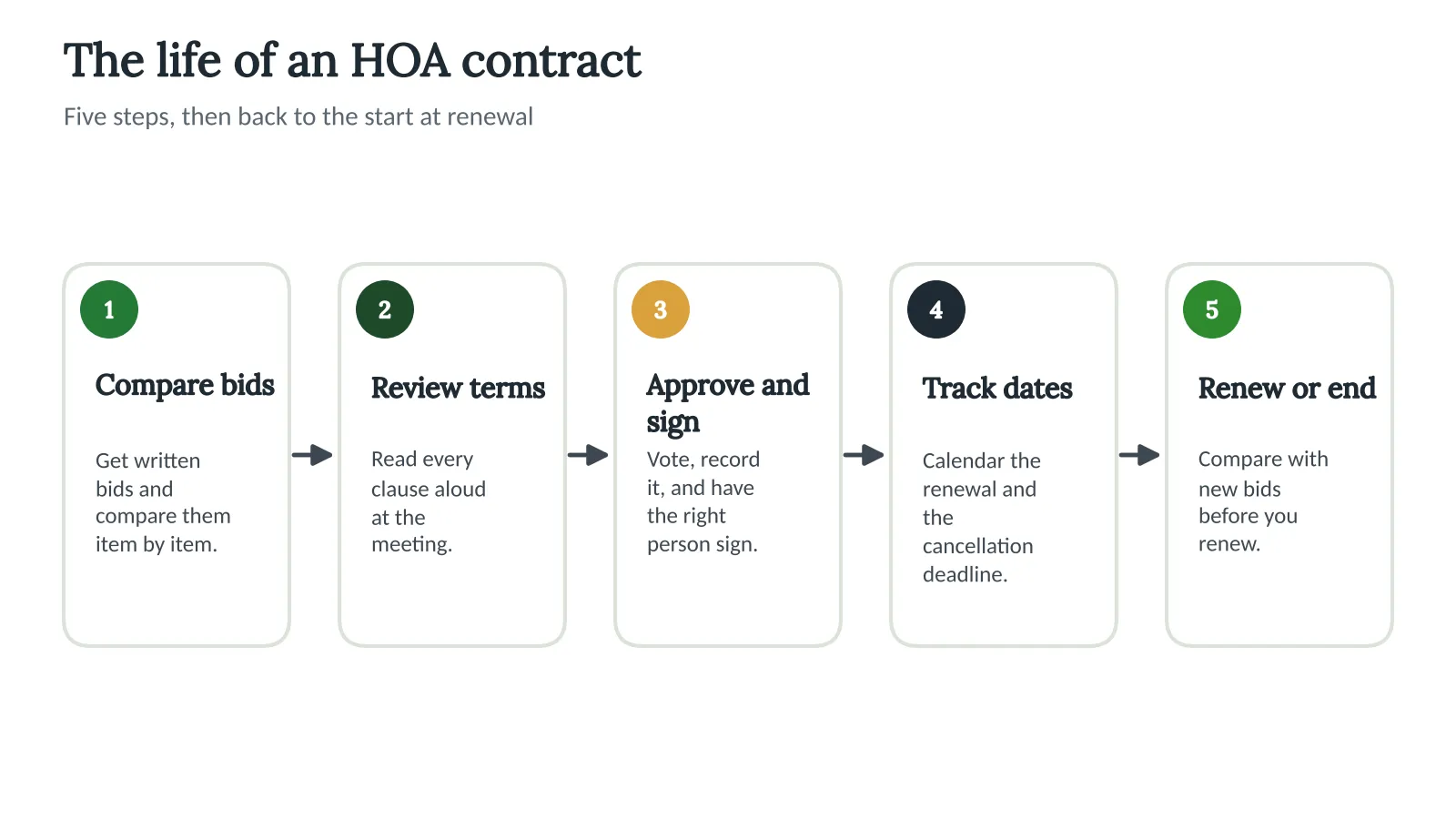
Contract management is mostly about four questions for each agreement: what does it say, when does it end, what must the vendor provide, and who is allowed to sign or cancel it. The picture below shows the life of a contract from first draft to renewal.
Here is a simple example. A 60-home association pays a landscaper $2,100 a month, or $25,200 a year. The agreement renews for another year unless the board gives 60 days’ written notice. If a 3% increase also applies on renewal, the new price is $2,163 a month, which is $25,956 a year. A board that misses the notice date has committed $25,956 without a vote.
Why It Matters for HOAs
Volunteer boards turn over, and paper and email do not hand off cleanly. A handful of causes explain the usual contract problems:
- Missed dates: automatic renewals and price increases arrive when nobody is watching.
- Missing insurance: a vendor’s coverage lapses, and the association learns about it after an accident.
- Unclear scope: the contract says “landscaping” and the vendor and the board disagree about what that means.
- Unclear authority: a board member signs without approval, or the documents require a vote and nobody held one.
- Lost copies: the signed agreement lives in one person’s email or garage.
Any of these can cost money, and the last two can also create legal trouble. A contract signed by someone without authority may not bind the association the way the board expects. Ask an attorney if you are unsure who can sign for your association. The bylaws are the usual place to look first.
How HOA Boards Should Handle It
A short routine works better than a complicated system. Use it for every new agreement and for every renewal.
Handle each agreement
- Collect bids. Ask for written bids from at least three vendors for any job the board considers significant, and compare them item by item.
- Read the terms. Use the checklist below before the board votes.
- Approve at a meeting. Follow your documents on who may approve, and record the vote in the minutes.
- Sign and file. Have the authorized person sign, then store the signed copy where every board member can reach it.
- Set reminders. Put the renewal date, the cancellation deadline and the insurance expiration date on a shared calendar.
- Review before renewal. Ask whether the vendor met the terms, and compare the renewal price with fresh bids.
Terms to check before signing
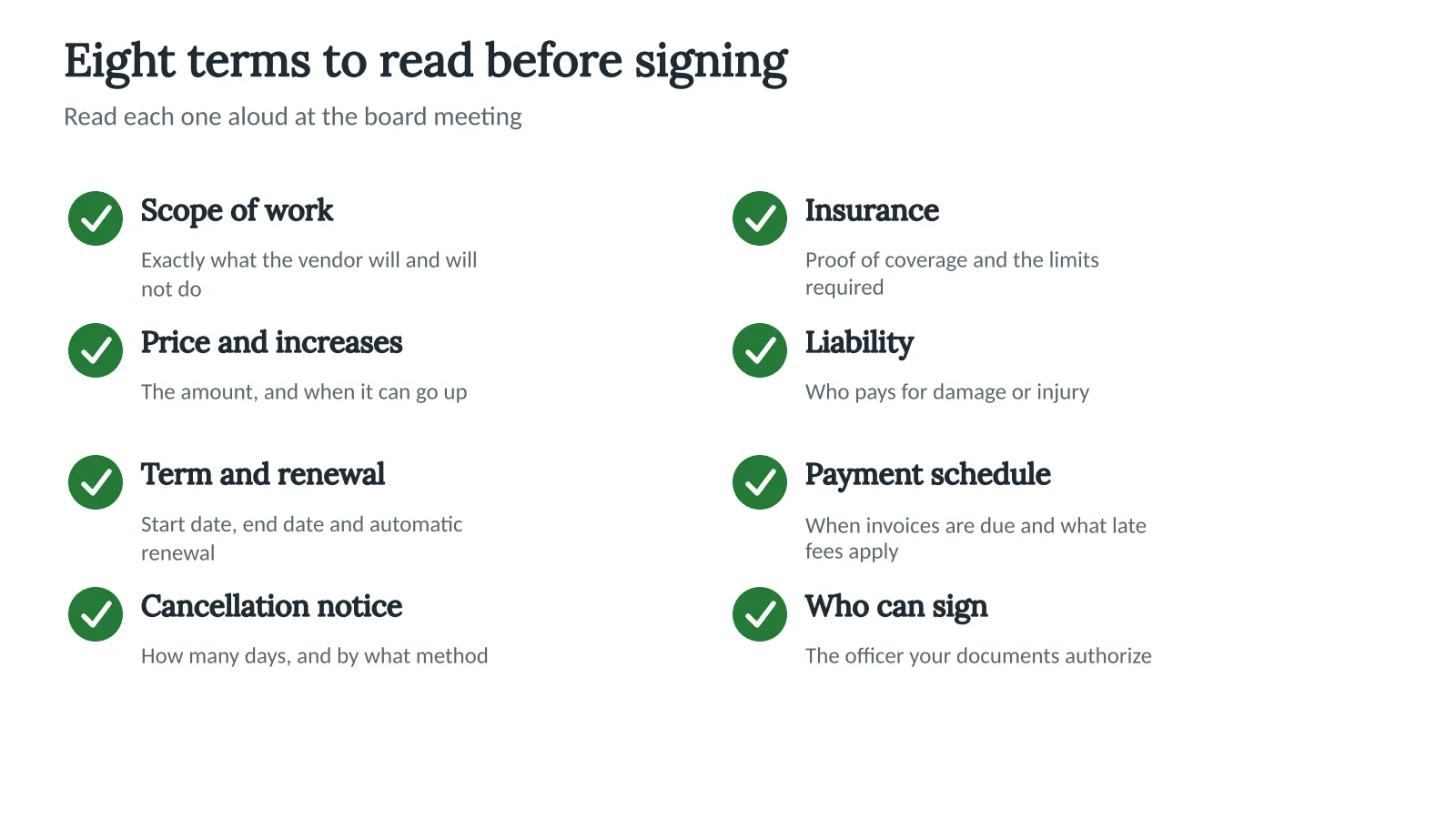
The picture below lists the terms worth a close read. Read each one aloud at the board meeting so nobody votes on a document they have not read.
Ask for a certificate of insurance from every vendor who works on the property, and ask your insurance agent what limits and what wording your association needs. Our overview of HOA insurance types explains the main coverages. Ask the vendor for a W-9 form up front, because your accountant will need it at tax time, and ask your accountant what reporting rules apply to your payments. For larger or longer agreements, have an attorney review the draft before signing. Our overview of how to choose reliable vendors covers how to compare bids and check references.
Signing electronically
A board can sign agreements electronically to avoid printing and scanning. The federal ESIGN Act says a signature or contract may not be denied legal effect only because it is in electronic form, and some kinds of records are excluded. Your governing documents or state law may add rules, so check them or ask an attorney before you move every signature online.
A good signing routine records who signed, when, and which version of the document they signed. Keep that record with the contract.
How Technology Can Help
The hardest part of contract management is remembering. A tool that shows every vendor in one list, with contract dates, insurance and W-9 status, answers the board’s usual questions at a glance. Neighborhood.online keeps vendors in one list and warns before insurance lapses or a contract runs out, so the cancellation deadline is not a surprise.
The signed agreement itself belongs with every other record. Neighborhood.online stores every document in one place, searchable inside, so the next treasurer can search for a vendor’s name and find the agreement, the insurance certificate and the meeting minutes where the board approved it. Our post on moving from file cabinets to digital document storage explains how to get started.
Key takeaways
- Track every agreement’s start date, end date, renewal terms and cancellation deadline in one list.
- Collect written bids, read the terms aloud at the meeting, and record the approval in the minutes.
- Ask every vendor for proof of insurance and a W-9 before work starts.
- Store signed copies where the whole board can find them.
- Check your documents and state law about who may sign and whether electronic signatures are allowed.
Frequently asked questions
What should an HOA vendor contract include?
At minimum, it should include the scope of work, the price and any increases, the start and end dates, how renewal and cancellation work, insurance requirements, who is responsible for damage or injury, the payment schedule and the name of the person who signed for the association.
Who can sign contracts for an HOA?
Your governing documents and state law decide. A board may authorize one officer to sign after the board votes. Ask an attorney if your documents are unclear.
Are electronic signatures valid for HOA contracts?
The federal ESIGN Act generally allows electronic signatures and records to be treated like paper ones, with some exceptions. Check your documents and state law, and ask an attorney about records that need special handling.
How long should an HOA keep old contracts?
Retention rules vary by state and by document. Ask your attorney and accountant how long to keep contracts, then keep the signed agreement, the insurance certificate and the board approval together.
Sources
- Cornell Law School Legal Information Institute. (n.d.). 15 U.S. Code § 7001: General rule of validity. law.cornell.edu


