
Community association governance: how a volunteer board can lead well

Two neighbors argue at the annual meeting about whether the board can change a rule on its own. Half the room thinks yes, half thinks it needs a vote, and the board president says she will look into it. Nobody is sure where to look.
That confusion is a governance problem. Community association governance is the set of rules, roles and habits that decide how a community makes decisions. This guide explains the pieces, how they fit together, and the habits that help a volunteer board lead with confidence.
What Community Association Governance Is
Governance means who can decide what, and how. In a community association, the answer comes from layers that sit on top of each other.
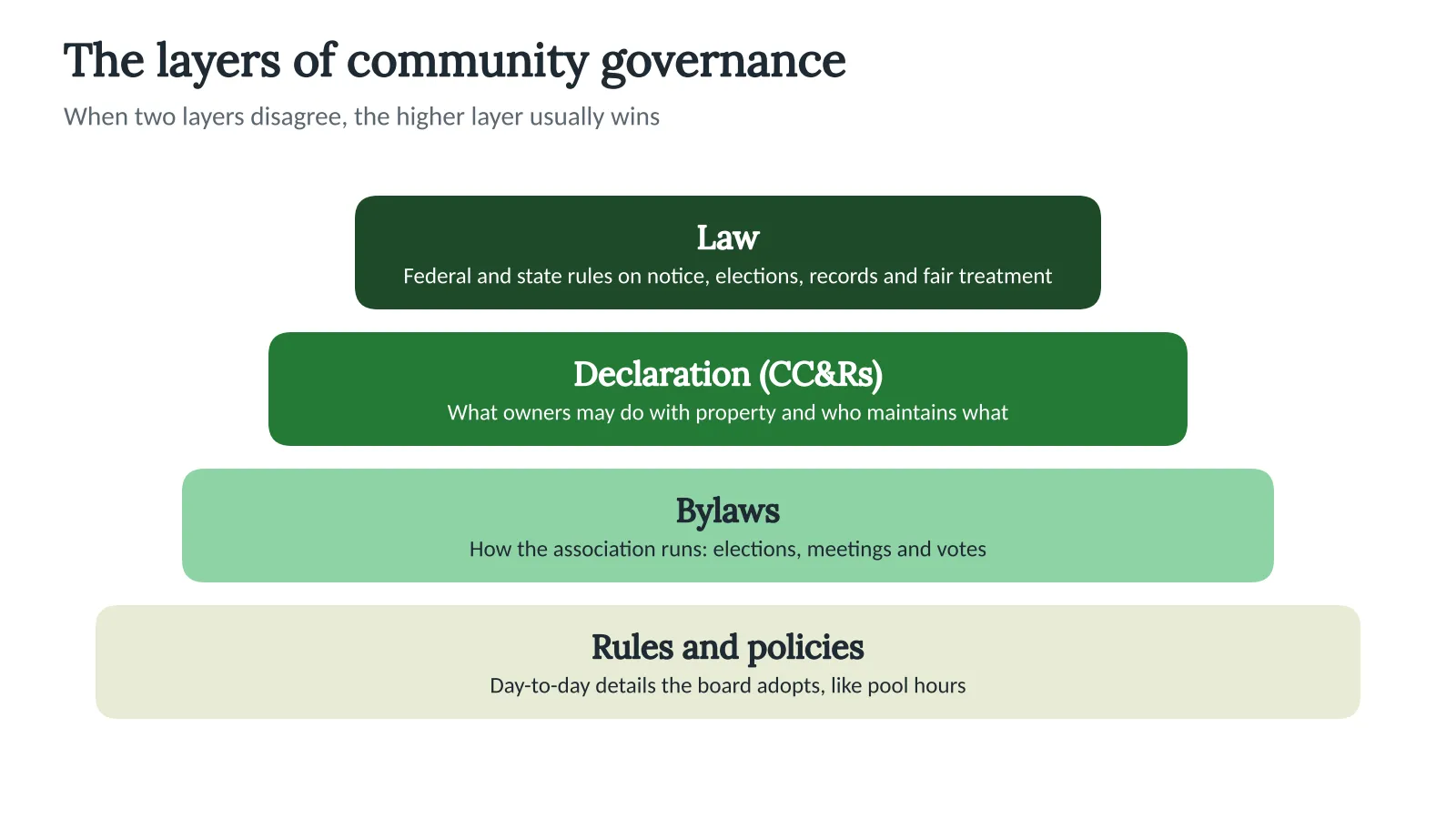
- Law: federal and state law set the outer limits, including requirements for notice, elections, records and fair treatment.
- The declaration, often called the CC&Rs: this sets what owners may and may not do with their property, and who maintains what.
- The bylaws: these explain how the association itself works, such as how the board is elected, how meetings run and how many votes make a decision.
- Rules and policies: these are the day-to-day details the board adopts, such as pool hours or how to request an exterior change.
Together, the declaration, bylaws and rules are your governing documents, the rulebook that explains how the neighborhood is supposed to run. When two layers disagree, the higher layer usually wins, and an attorney can tell you for sure. Our guides to CC&Rs and HOA bylaws go through each in plain language.
Here is a simple example. The board wants to ban overnight guest parking on the community’s private street. It checks the layers in order: state law does not prohibit it, the declaration is silent on parking, and the bylaws let the board adopt rules. A board rule is probably allowed. If the declaration had said guests may park overnight, the board would need to amend the declaration, not just adopt a rule.
Why It Matters for HOAs
Good governance protects the community, and it protects the volunteers. A board that follows the right steps can show owners and, if needed, a court that it acted in good faith. A board that guesses invites complaints, lawsuits and burnout.
Governance problems tend to show up in a few places:
- Decisions made outside the process: an email vote, a rule adopted without notice, or a decision made by one person.
- Unclear roles: the president, the treasurer and the manager each think someone else is handling a task.
- Hidden decisions: owners find out about a change after it takes effect.
- Uneven enforcement: two owners break the same rule and get different results.
- No handoff: new board members start without the history.
None of this means the board is acting in bad faith. Governance problems often come from not having a simple routine.
How HOA Boards Should Handle It
Strong governance rests on four habits: know your documents, work in the open, treat owners the same way, and keep records.
Know your documents
Read the declaration and bylaws together, at least once a year, and mark the sections about the board’s powers, meetings, elections, budgets, enforcement and amendments. Keep the current version and every amendment in one place. Ask an attorney to explain any section the board cannot agree on.
Work in the open
Hold regular meetings with a published agenda, and share approved minutes and financial reports with owners. Explain why the board made each decision, not only what it decided. Our guides to HOA meetings and executive sessions explain which topics may be discussed privately and which belong in the open. Our guide to financial transparency covers the money side.
Treat owners the same way
Write down enforcement steps and follow them every time: a friendly reminder, a written notice, a chance to respond and a decision. Give every owner the same chance to be heard. Our post on selective enforcement explains why consistency protects the board.
Keep records
Write down decisions and the reasons for them. When the next board asks why a rule changed, the minutes should answer.
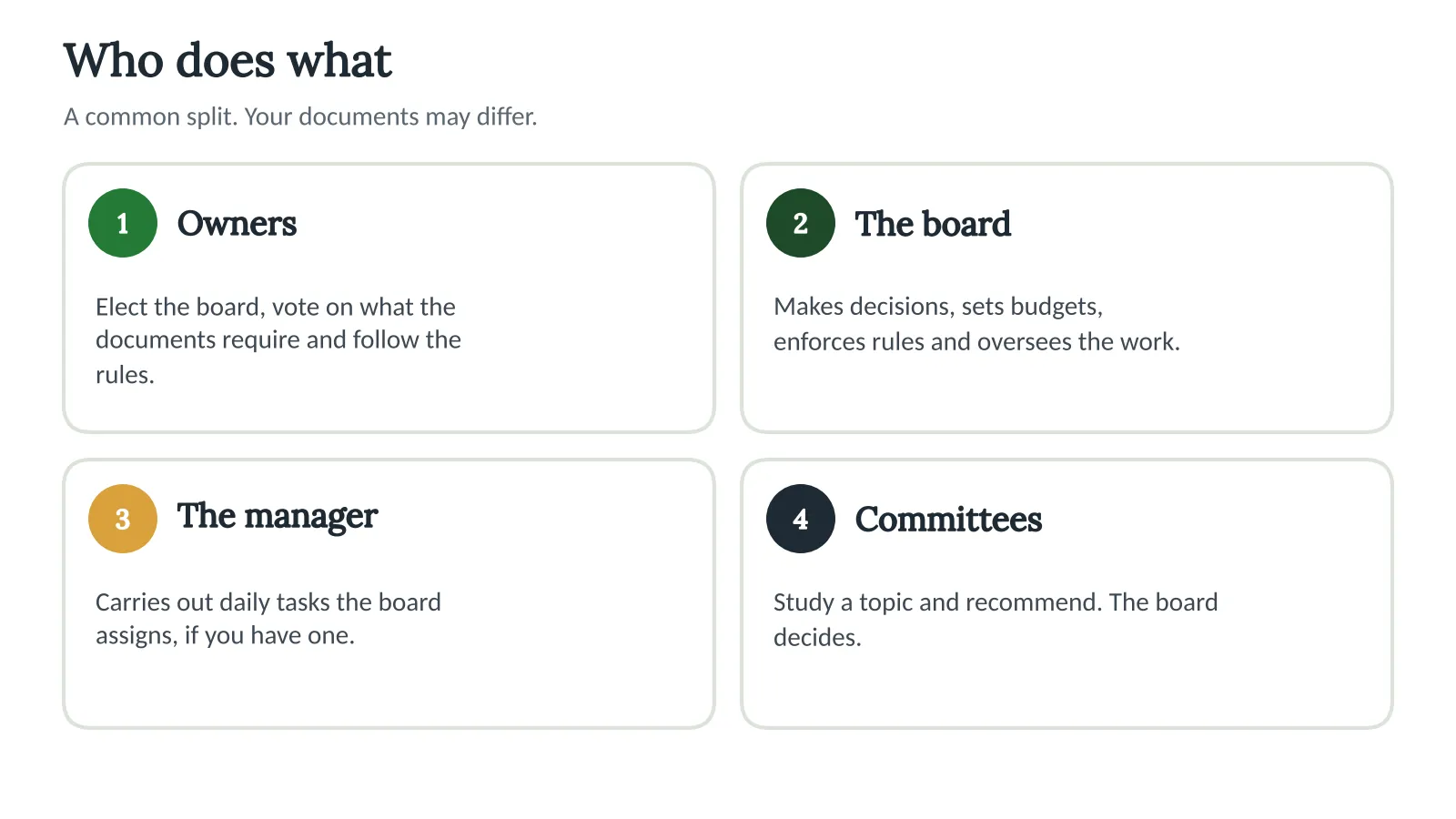
Give each role a clear job
Run a simple decision routine
- Check the layers. Does law or your documents already answer the question?
- Put it on the agenda. Give owners notice that the topic will be discussed.
- Discuss and vote at a meeting. Record who proposed it, who voted and how.
- Tell owners. Explain the decision, the reason and the date it takes effect.
- File the record. Store the minutes and any new rule with the governing documents.
Training helps too. Each new board member should read the governing documents, sit in on a meeting before taking a seat, and meet the people they will work with. Our post on what a transition means for a board is a useful read for communities moving from developer control to owner control, and the checklists in our resource center can help.
How Technology Can Help
Governance depends on being able to find things. The declaration, the amendments, last year’s minutes and the vote that approved a policy need to be reachable by whoever is on the board today. Neighborhood.online keeps every document in one place, searchable inside, so the next board has the whole history.
It also helps with the routines above. Board meetings run step by step: the agenda starts with standing items filled in, the notice goes out on time, and minutes are drafted from the meeting. Rules live in one place in plain language, and violations follow the same steps every time, quoting the rule from the community’s own documents. When the board needs owners to vote, votes are online with one vote per lot, ballot links work without an account, and results are counted and kept on file, where your documents allow it.
Key takeaways
- Governance is who can decide what, and how, and it comes from layers: law, the declaration, the bylaws and board rules.
- Check the layers before deciding, and ask an attorney when they disagree.
- Work in the open with published agendas, minutes and reports.
- Enforce the same way for every owner and write down the reason for every decision.
- Keep every document and record where the next board can find it.
Frequently asked questions
What is community association governance?
It is the framework of laws, governing documents, board roles and routines that decide how a community association makes decisions and treats its members.
What is the difference between the CC&Rs and the bylaws?
The CC&Rs, or declaration, set the rules for property use and who maintains what. The bylaws set how the association itself runs, including board elections and meetings.
Can the board change a rule without a vote of the owners?
Sometimes. Boards can often adopt rules that fit within the documents. Changing the declaration usually needs an owner vote. Check your documents and state law, and ask an attorney if you are unsure.
How can a board improve governance quickly?
Read the governing documents together, publish agendas and minutes, write down enforcement steps, and store every record in one place. Those four habits help prevent common problems.


